

CHEXX Singapore Guide
Verification guide
CHEXX KYC: When Verification Can Be Triggered
CHEXX’s stated KYC position is that identity verification is not required by default and can be triggered when suspicious activity is detected. That is narrower than saying CHEXX is permanently “no KYC”: a conditional check can still become relevant after an account has been opened. Country declaration is part of the normal account information, while a later identity check is a separate process.
CHEXX does not provide a standard document list or a universal verification time for this policy. Specific document types and processing-time requirements therefore cannot be stated as universal rules. If CHEXX requests verification on an account, follow the request shown in the account rather than relying on a generic casino checklist.
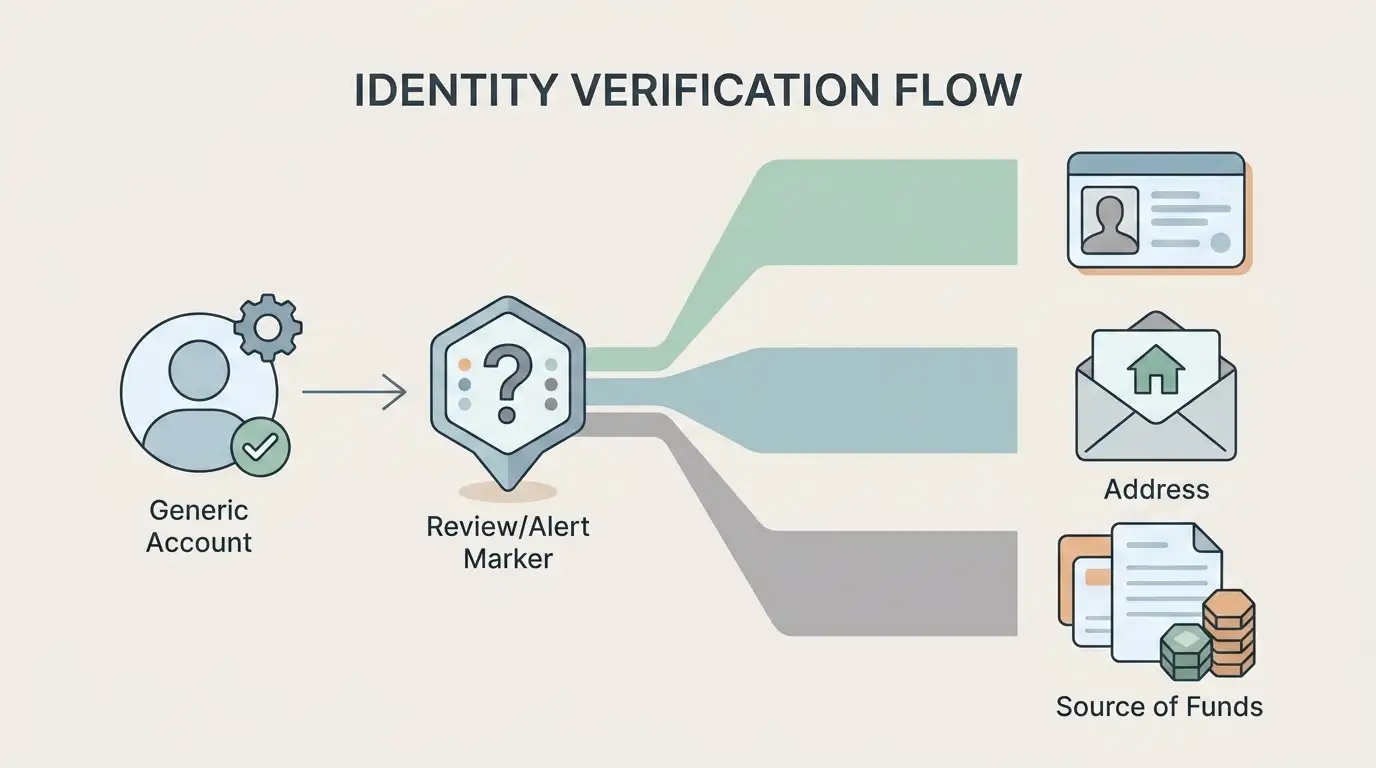
The key distinction: default signup versus conditional KYC
The most important point is the difference between account creation and a later verification trigger. The CHEXX registration guide covers how an account is created. KYC is a separate control that can be activated when suspicious activity is detected. A person can therefore complete the normal signup flow without that fact proving that identity checks can never be requested later.
This distinction avoids two opposite mistakes. The first is calling CHEXX a guaranteed no-KYC casino, which goes further than the stated policy. The second is assuming that every account must submit documents as part of ordinary registration, which is also not the stated default. The accurate position sits between those claims: KYC is conditional rather than universal at signup.
Country declaration should also be kept separate from identity verification. Declaring a country is standard account information. It does not by itself amount to a full document-based identity check, and it does not settle whether a later KYC review will be triggered.
What CHEXX states and what this page does not add
| Question | CHEXX position used here | What not to assume |
|---|---|---|
| Is KYC required by default? | No. The stated position is that it is not required by default. | Do not turn that into a permanent no-KYC promise. |
| When can KYC be triggered? | When suspicious activity is detected. | Do not treat other possible checks as universal standard triggers. |
| Is country information part of signup? | Country declaration is part of the account model. | Do not describe country selection as full identity verification. |
| Which documents are always required? | No standard document list is supplied here. | Do not publish a standard document checklist without direct support. |
| How long does verification always take? | No universal processing time is supplied here. | Do not promise minutes, hours or a fixed number of days. |
The table is deliberately specific about the boundary. It gives a direct answer where CHEXX’s position is clear and leaves fields blank where a standard rule is not supplied. That is more useful than filling the gaps with requirements borrowed from another operator or from a general KYC article.

Why a no-KYC headline would be misleading
“No KYC” can sound like a permanent product feature, but the CHEXX position does not support that interpretation. A conditional trigger means an account can move from ordinary use into verification if suspicious activity is detected. The fact that a check is not required by default says nothing about whether a specific account will avoid review forever.
That matters most when a reader is comparing operators on the assumption that cryptocurrency removes identity checks. The payment rail and the identity policy are separate. Crypto deposits or withdrawals do not cancel an operator’s ability to apply a KYC process under its stated rules.
A more accurate decision question is therefore: “Am I comfortable using a service where KYC is conditional and the exact document list and timing are not specified here?” That question reflects the information actually available without turning uncertainty into a sales claim.
How KYC can matter around withdrawals
Verification and withdrawals are separate topics, but they can intersect. If suspicious activity triggers a KYC review, that check can become relevant while an account holder is trying to access funds. This does not mean every CHEXX withdrawal requires KYC, and it does not support a claim that every withdrawal follows the same review sequence.
The practical way to keep the topics straight is to treat withdrawal mechanics and identity checks as two layers. The CHEXX withdrawals guide covers the crypto cashout side. This page covers the condition under which identity verification can enter the picture. Keeping those layers separate prevents a network minimum or a wallet-processing point from being mistaken for a KYC rule.
Because no universal KYC processing time is supplied here, this page also avoids promising a withdrawal completion time that depends on identity review. A fixed number would create precision that the CHEXX KYC information does not provide.
What to do if an account receives a verification request
Use the request shown inside the CHEXX account as the controlling instruction. Check that you are on the official service before entering personal information, and read the requested fields before submitting anything. This is basic account-safety guidance rather than a claim about which documents CHEXX will ask every user to provide.
Do not upload extra identity material simply because a generic casino guide says it is commonly requested. The absence of a standard document list on this page is intentional. A request that names a specific item should be handled as that account’s request; it should not be converted into a universal checklist for every CHEXX user.

The same approach applies to timing. If the account interface gives a status or instruction after submission, use that account-specific information. This guide does not substitute a guessed processing window for a duration that is not established as a general CHEXX rule.
Registration, KYC and account security are different layers
Registration answers how credentials or an account relationship are created. KYC answers whether additional identity verification is triggered. Account security answers how a user protects access to the account. Combining those topics can create unsupported claims, such as treating a wallet connection as proof that identity checks are impossible or treating a country declaration as a document-based KYC check.
The separation also keeps the page focused. The KYC policy described here should not be expanded into claims about two-factor authentication, phone verification, biometric checks or account recovery. Those are separate account-security features and are not part of the stated KYC trigger.
KYC does not decide Singapore legal status
An operator can use identity checks without holding a Singapore remote-gambling licence, and the absence of default KYC would not make a gambling service locally authorised. KYC is an account-control question. Singapore licensing is a jurisdiction question.
For that reason, a Singapore reader should not use the presence or absence of verification as a shortcut for legality or consumer protection. The Singapore gambling law guide covers local remote-gambling rules, while the CHEXX licence and trust guide covers the operator, licence jurisdiction and safeguards. Those questions remain separate from the KYC trigger described here.
A decision framework for the CHEXX KYC policy
- Start with the actual default: KYC is not required by default.
- Keep the trigger visible: suspicious activity can activate identity verification.
- Do not demand false precision: this page does not publish a universal document list or processing time.
- Plan for conditional review: do not choose the service on the assumption that verification can never happen.
- Separate cashier and identity rules: a crypto withdrawal and a KYC review are different processes even when they affect the same account.
- Separate KYC from local law: identity policy does not determine Singapore authorisation.
This framework is intentionally narrower than a generic KYC explainer. Its purpose is to state the CHEXX rule directly, show what it does not establish, and avoid filling missing policy fields with assumptions.
The policy boundary is part of the decision
CHEXX does not specify a standard document list or a fixed verification time for this policy. The trigger can therefore be stated directly, but the later verification process should not be turned into a predictable checklist. Anyone who needs certainty about exact documents or timing should rely on the instructions shown for the individual account if verification is requested.
That does not justify assuming the strictest possible process either. The correct boundary is narrower: KYC is not required by default, suspicious activity can trigger it, and the exact documents and duration are not specified here. Keeping all three points together avoids both an overly reassuring no-KYC claim and an unsupported worst-case procedure.

Frequently asked questions
Is CHEXX a no-KYC casino?
Not as a permanent guarantee. CHEXX states that KYC is not required by default, but verification can be triggered when suspicious activity is detected.
Does every CHEXX account submit identity documents at signup?
No default document submission is stated here. Country declaration is part of account information, while KYC is a separate conditional process.
Which documents does CHEXX always require?
CHEXX does not publish a universal document list for this policy. Follow the specific request shown in the account if verification is triggered.
How long does CHEXX KYC take?
CHEXX does not state a universal verification time, so no fixed duration should be assumed.
Does KYC mean CHEXX is authorised in Singapore?
No. Identity checks and Singapore remote-gambling authorisation are separate questions.
Related CHEXX guides
For the full platform context, return to the CHEXX Singapore review.
The full picture is in our CHEXX review for Singapore.
Verification matters most at withdrawal time.
 Epic JourneyRed Tiger Gaming
 Astro GemsMaverick
 Rich WorldAmusnet
 GemonexBetixon
 Sugar RushPragmatic Play
 The Book of AmaterasuMascot Gaming
 Sizzling Hot DeluxeNovomatic
 Fruit CocktailIgrosoft
 Love Gems Hold and Win1spin4win
 The Boom SquadGenesis Gaming
 Sweet FTNGameArt
 Boogie BoomBooming Games
 StarburstNetEnt
 Lollipop Drop MultiMaxBulletproof Games
 American BlackjackClassic
 Ultimate Blackjack with RachaelLive-style
 Quantum Blackjack PlusMultiplier
 Atlantic City BlackjackClassic
 Single Deck Blackjack GoldSingle Deck
 Vegas Downtown Blackjack GoldGold Series
 Double Exposure BlackjackDouble Exposure
 Vegas Strip BlackjackClassic
 Perfect Pairs BlackjackSide Bet
 Blackjack Surrender OriginsSurrender
 Blackjack Lucky LadiesSide Bet
 VIP American BlackjackVIP
 Classic BlackjackClassic
 European BlackjackMultihand
 Blackjack 21 ClassicClassic
 Roca Riches RouletteThemed
 RouletteRelax Gaming
 Dragon RouletteThemed
 French RouletteNetEnt
 Mega Fire Blaze RouletteMultiplier
 American RouletteClassic
 Lucky RouletteClassic
 Mini Roulette 3DMini
 Monopoly Roulette TycoonThemed
 Multifire RouletteMultiplier
 Auto RouletteSwitch Studios
 Immortal Romance RouletteThemed
 Gold RouletteGold Series
 Quantum RouletteMultiplier
Published by the Chexx Casino team.